Denoising
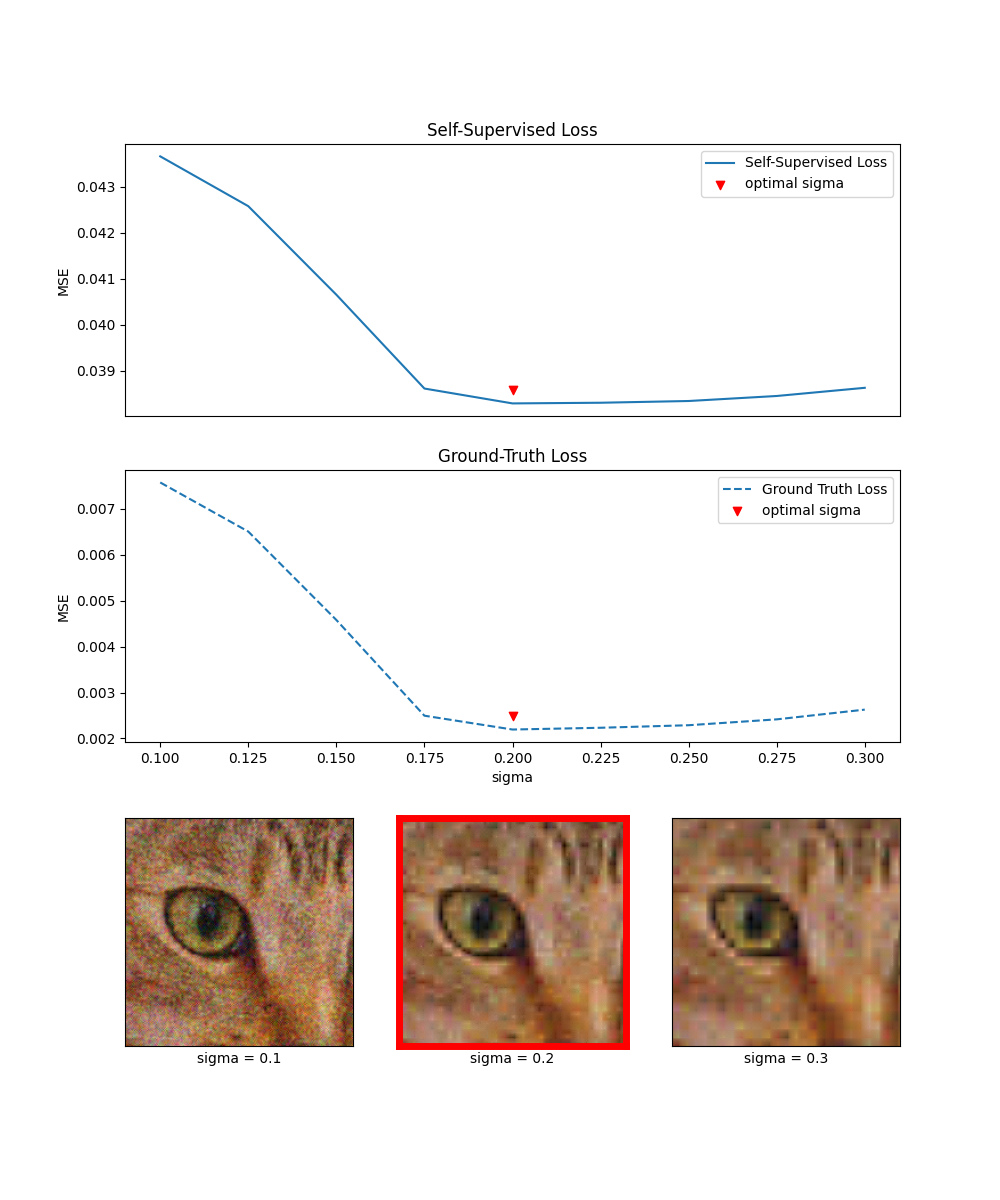
HyperGas applies a Chambolle total variance denoising (TV) filter with the J-Invariance calibration to generate a smoothed gas enhancement field. The denoising example on the scikit-image website explains it clearly. Below is an image showing the differences in denoised results using various weights:
Here is a real-world example of a denoised methane field using three different weights:
>>> from hypergas.denoise import Denoise

>>> # denoise data and get calibrated weight
>>> ch4_denoise = Denoise(hyp.scene, varname='ch4', method='calibrated_tv_filter').smooth()
>>> denoise_weight = float(ch4_denoise.attrs['description'].split('weight=')[1][:-1])

>>> # test different weights
>>> ch4_denoise_low_weight = Denoise(hyp.scene, varname='ch4', method='tv_filter', weight=denoise_weight/2).smooth()
>>> ch4_denoise_high_weight = Denoise(hyp.scene, varname='ch4', method='tv_filter', weight=denoise_weight*2).smooth()

>>> # plot results
>>> fig, axs = plt.subplots(nrows=2, ncols=2, figsize=(10, 8))
>>> axs = axs.flatten()

>>> hyp_emit.scene['ch4'].where(hyp_emit.scene['segmentation']>0).plot(ax=axs[0], vmin=0, vmax=150)
>>> ch4_emit_denoise_low_weight.where(hyp_emit.scene['segmentation']>0).plot(ax=axs[1], vmin=0, vmax=150)
>>> ch4_emit_denoise.where(hyp_emit.scene['segmentation']>0).plot(ax=axs[2], vmin=0, vmax=150)
>>> ch4_emit_denoise_high_weight.where(hyp_emit.scene['segmentation']>0).plot(ax=axs[3], vmin=0, vmax=150)

>>> axs[0].set_title(f'Original data')
>>> axs[1].set_title(f'Denoising weight = {int(emit_denoise_weight/2)}')
>>> axs[2].set_title(f'Denoising weight = {int(emit_denoise_weight)}')
>>> axs[3].set_title(f'Denoising weight = {int(emit_denoise_weight*2)}')

>>> for ax in axs:
>>>     ax.set_xlim(700, 800)
>>>     ax.set_ylim(250, 350)
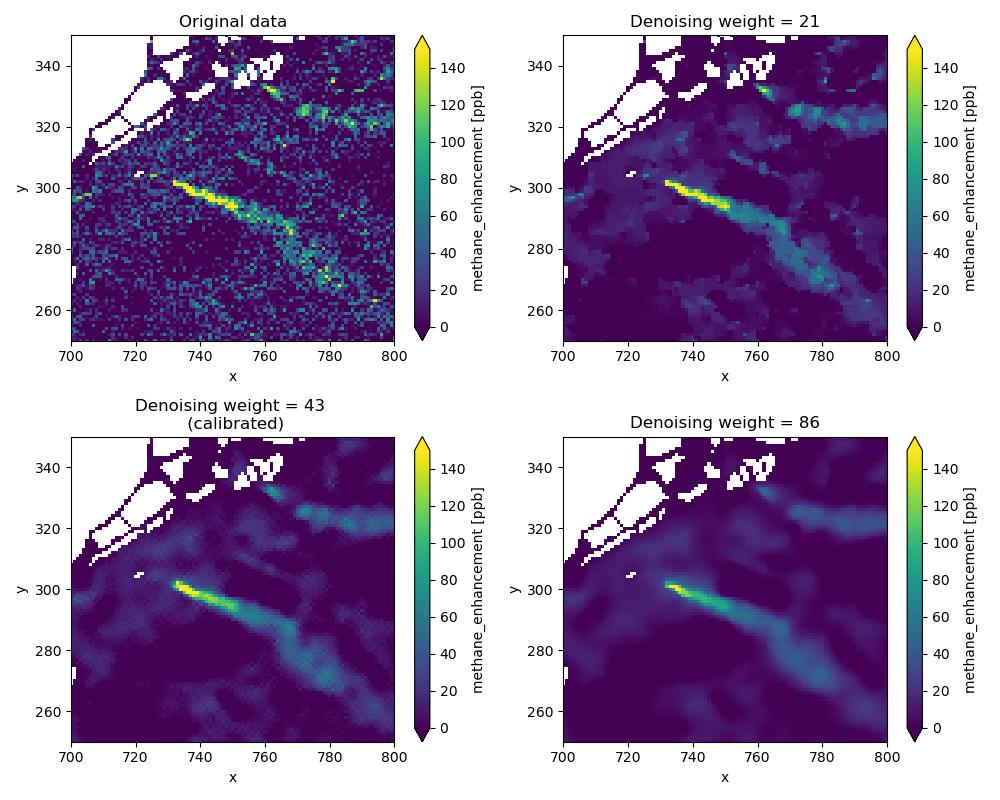
The TV filter with calibrated weight effectively removes background noise while preserving the structure of the gas plume. In contrast, using the doubled weight over-smooths the field and obscures important features.